
.png?width=200&height=86&name=RBP_Logo-Design_02%20(1).png "RBP White Logo")

 Adam Sand
3 min read
How RAG and Vectorized Data Turn AI into Your Business’s Second Brain
AI chatbots don’t fail because they’re dumb—they fail because they don’t know your business. Here’s how vectorized data and RAG fix that. ...
Let me guess what happened.
You bought a CRM.
You built pipelines.
You added automation.
You trained the team.
And somehow… it got worse.
Reporting is unreliable.
Production can’t see what sales promised.
Customers get duplicate texts.
Your admin team is constantly “cleaning things up.”
You don’t have a CRM problem.
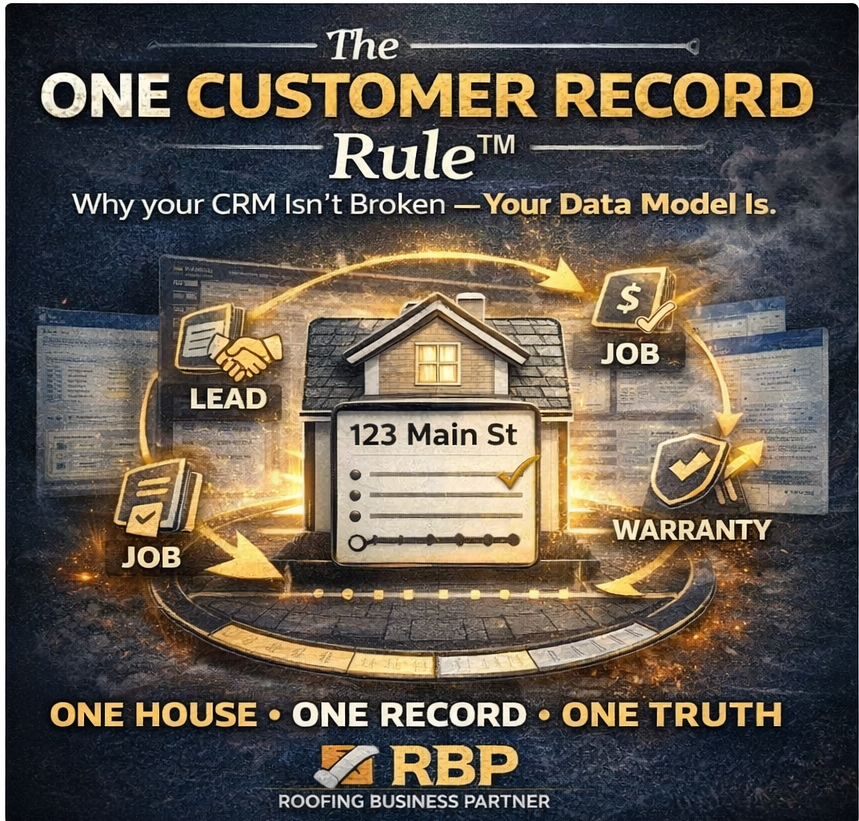
You have a One Customer Record problem.
And it’s the most expensive invisible issue in roofing operations.
Because when one homeowner becomes five different records… your CRM stops being a system.
It becomes a fight.
Here’s the uncomfortable truth:
Most CRMs don’t fail because they’re missing features.
They fail because they’re missing truth.
And truth in a business requires one thing:
✅ A single source of reality for each customer.
That’s why I built a rule we use with every roofing company we work with:
One house. One record. One timeline. One truth.
Everything — sales, production, billing, warranty, supplements, and referrals — attaches to the same customer record.
If your company doesn’t follow this rule, your CRM becomes a duplicate factory.
And duplicates are what create:
silos
confusion
inefficiency
and the “CRM nightmare” everyone blames on the software
In most roofing companies, one homeowner ends up with multiple “truths.”
Here’s what that looks like:
“Customer approved synthetic underlayment and upgraded ridge cap.”
“Job is scheduled as standard install. Nobody knows about upgrades.”
“Invoice doesn’t match signed contract.”
“We can’t find the job in the system.”
“You people are not organized.”
And once a customer feels that… your trust disappears.
The job still gets done.
But reviews suffer.
Referrals stop.
And your marketing becomes more expensive over time.
Duplicate records don’t just create annoyances.
They create financial leakage.
Because every duplicate record causes:
missed follow-up
wrong pricing
delayed scheduling
slower invoicing
and customer confusion
which drives cancellations
This is what we call the Duplicate Tax.
And it’s brutal because it doesn’t show up as a line-item expense.
It shows up as:
lower conversion
longer cycle times
more call volume
more chaos
and higher churn
It’s death by a thousand cuts.
And the worst part?
Most owners don’t even know it’s happening.
This is one of the core mistakes roofing companies make when designing their CRM.
CRMs were built for people.
Roofing is built around properties.
That means the center of your CRM should not be:
❌ “John Smith”
It should be:
✅ “123 Main St”
Because one property can have:
multiple homeowners
multiple decision makers
multiple claims
multiple jobs over time (repair → replacement → gutters → siding)
The property stays the anchor.
People come and go.
If your CRM isn’t property-first, you will eventually create duplicates.
It’s inevitable.
Here’s what a healthy roofing data model looks like:
Address
Roof type
Measurements
Notes
History
Homeowner
Spouse
Insurance adjuster
Property manager
Pipeline stage
Estimate
Financing
Sales notes
Quote versions
schedule
materials
crews
inspections
completion photos
invoice
deposits
supplements
collections status
warranty start date
issues
repairs
callbacks
Everything attaches to the same property timeline.
That’s how a CRM becomes an operating system.
Most “all-in-one” systems promise you simplicity.
But they usually create complexity through:
duplicate objects
unclear definitions
department-based workflows
and multiple integrations creating multiple records
This is why you get:
3 CompanyCam projects per house
2 measurement reports
2 different job names
5 different “customer notes”
And nobody knows which one is real.
Your CRM becomes a place where truth goes to die.
If you want your CRM to become Mission Control, this is the rule:
Your CRM should answer:
Where did this lead come from?
What did they get quoted?
What did they sign?
When is install scheduled?
What photos exist?
What’s outstanding financially?
Who owns next action?
Has the customer been asked for a review?
Is there a referral opportunity?
In one place.
Not across six tools.
Here are three questions that instantly reveal whether you have shadow duplication:
If the answer is more than two, you’re at risk.
If it’s more than one… you don’t have a system.
If yes, silos are already forming.
Here’s the simple escape path.
Not easy — simple.
Decide where the official customer record lives.
For most companies, this should be the CRM.
Not your measurement tool.
Not CompanyCam.
Not your production calendar.
The CRM is where truth lives.
Define what each thing is:
What is a lead?
What is a contact?
What is a deal?
What becomes a job?
When does a job become a customer?
If definitions aren’t shared, every department will build their own reality.
Your CRM must prevent duplicate records.
Address should be the matching key.
Not the name.
Two people can share a name.
One house can’t share an address.
This is the hard one.
Most duplicates come from:
integrations
“helpful” admins
sales reps creating new contacts instead of searching
and disconnected tools creating records automatically
You have to decide who is allowed to create new records — and how.
You can’t build automation on messy truth.
Clean the duplicates first.
Then scale.
When you enforce the One Customer Record Rule™, everything improves:
✅ Follow-up becomes consistent
✅ Production gets the right info
✅ Customer communication becomes clean
✅ Reporting becomes reliable
✅ Integrations stop creating chaos
✅ Automation finally works
✅ Your business becomes easier to run
And the biggest shift?
Your team stops treating the CRM as punishment.
They start treating it as the operating system it’s meant to be.
If you’re stuck in CRM frustration, don’t buy a new system.
First, ask this:
If the answer is no…
That’s the real reason your CRM feels like more work.
Pull a list of your last 50 completed jobs.
Search those addresses in your CRM.
Count how many duplicate records exist per address.
Identify where duplicates are coming from (people or integrations).
Build a rule to stop it.
CRMs don’t create clarity.
Truth does.
And truth starts with one record per customer.
Because you can’t scale on top of confusion.
At RBP Roofing Business Partner, we help roofing companies build a CRM that functions like Mission Control, not a messy contact list.
If you want an expert to map your data model, clean duplication, and redesign your system for scalability — that’s what we do.
You only get one name.
Your reputation is everything.
And what’s right is right.

3 min read
AI chatbots don’t fail because they’re dumb—they fail because they don’t know your business. Here’s how vectorized data and RAG fix that. ...
 Adam Sand : Jan 21, 2026, 7:00:00 AM
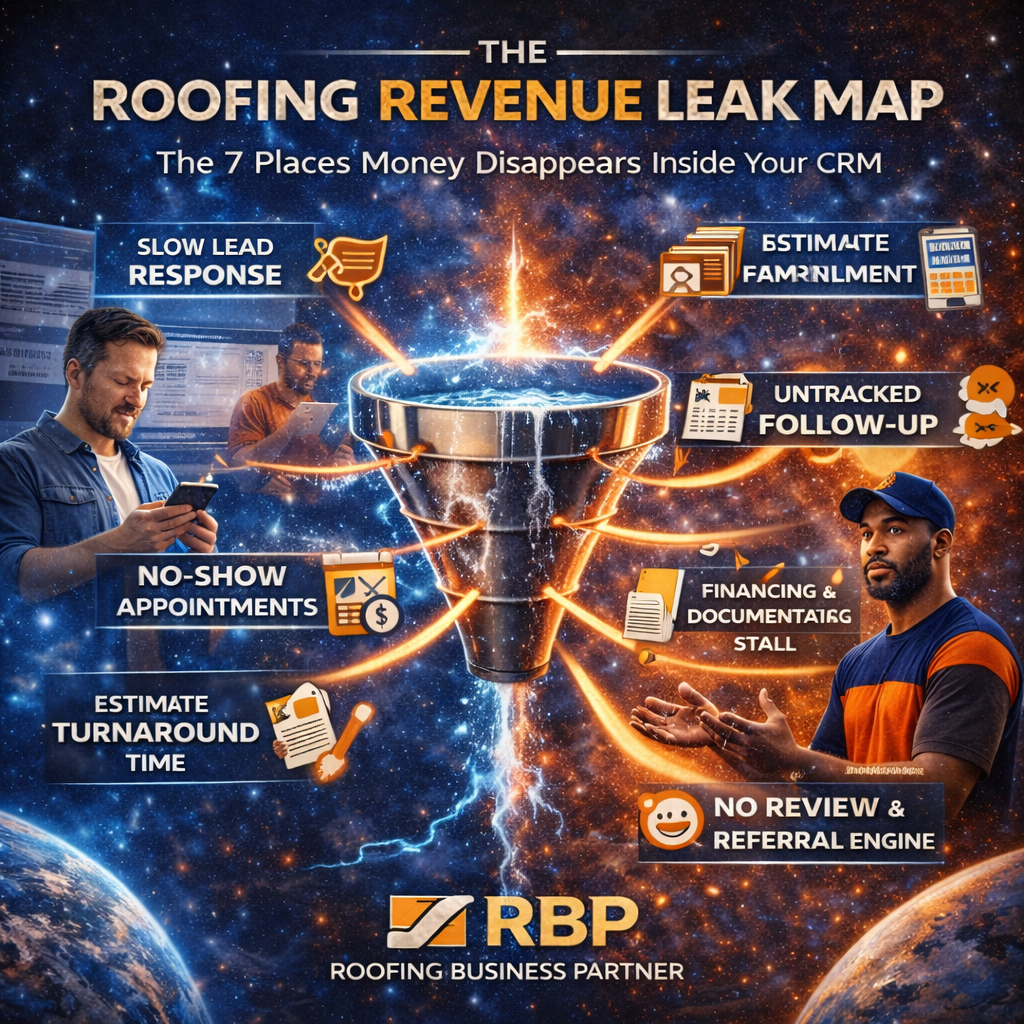
The 7 places money disappears inside your CRM — and how to stop it. Most roofing companies don’t have a revenue problem.

Stop writing generic job postings. Learn how targeted, candidate-focused messaging transforms your hiring results—and helps you build a...