Every roofer eventually asks the same question:
“What’s the best CRM?”
And I get it.
Your systems feel messy.
Your team feels disconnected.
You can’t trust reports.
Nobody follows the process.
Customers fall through cracks.
So you assume the fix is a better CRM.
But here’s the uncomfortable truth:
Most roofing companies don’t need a new CRM.
They need Mission Control.
Because roofing isn’t a “CRM business.”
Roofing is an orchestration business.
And if your CRM isn’t orchestrating your entire customer journey…
It’s not a CRM.
It’s a contact list with a logo on it.
Why Roofing Breaks Normal CRM Thinking
Traditional CRMs were designed for businesses that sell:
Roofing is not that.
Roofing is:
-
high ticket
-
high stress
-
low frequency
-
high trust
-
multi-department
-
multi-vendor
-
and full of surprises
Your customer journey moves through:
-
marketing
-
sales
-
inspection
-
measurement
-
estimating
-
financing
-
supplements
-
production scheduling
-
materials delivery
-
crews
-
change orders
-
billing
-
warranty
-
and reviews/referrals
That’s not a CRM job.
That’s an operating system job.
And that’s why normal CRM setups fail in roofing.
They aren’t built to control the complexity.
The Real Roofing Problem: Disconnected Systems
Most roofing companies don’t have “one system.”
They have six or eight.
Your team is using tools like:
Each tool solves a real problem.
But together?
They create a bigger problem:
Nobody knows what’s happening.
So owners do what owners always do:
-
they ask more questions
-
they add more spreadsheets
-
they create more meetings
-
they demand updates
-
and the company gets slower
This is the root of owner-dependency.
Not laziness.
Not bad people.
Bad system design.
Mission Control: The Roofing CRM Reframe
A roofing CRM should not be a “sales tool.”
It should be Mission Control.
Meaning:
Your CRM must coordinate every department through one customer timeline.
One version of truth.
One place where:
If your CRM can’t do that…
it isn’t a CRM.
It’s a digital filing cabinet.
What Mission Control Must Control
Here’s the litmus test.
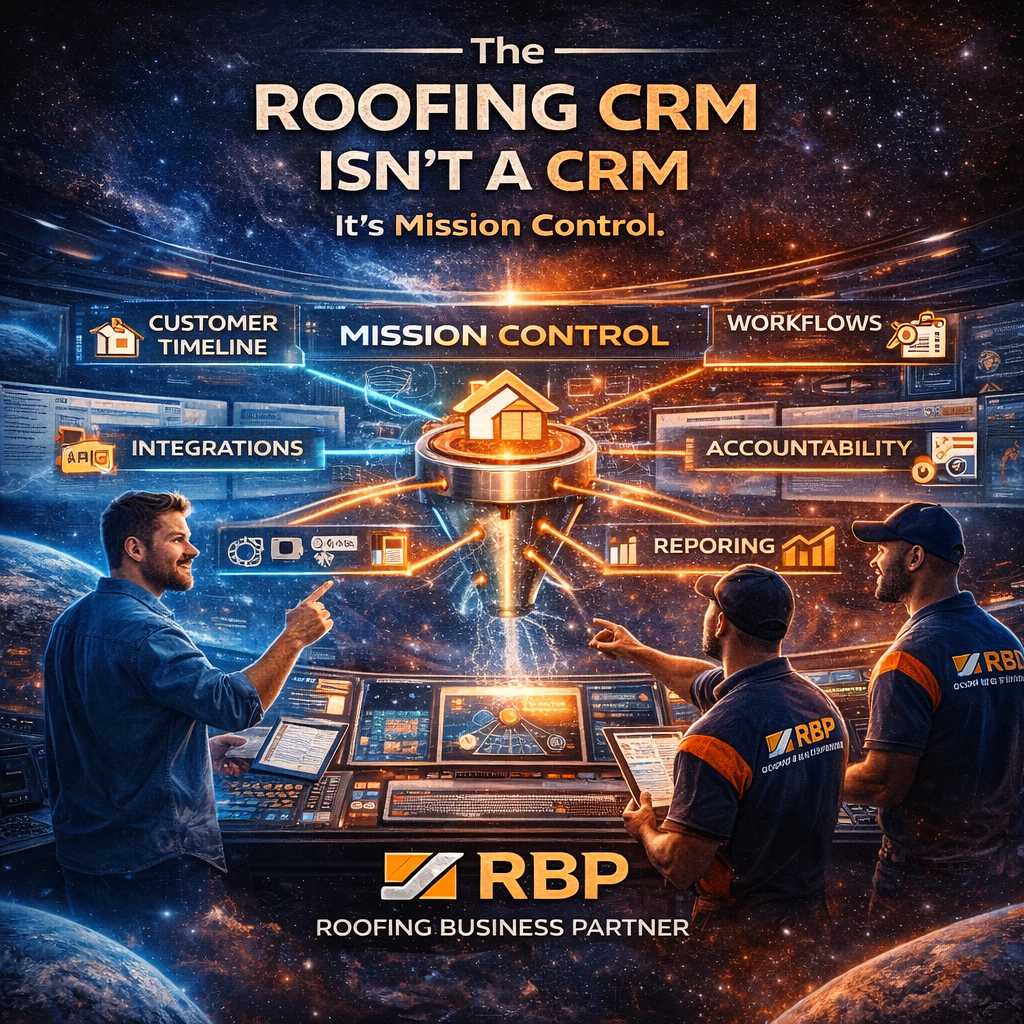
A true roofing Mission Control system must control five things:
1) The Customer Timeline (Truth)
A homeowner shouldn’t have five records.
Sales should see what production sees.
Production should see what sales promised.
Finance should see what was signed.
Warranty should see history instantly.
Mission Control requires:
✅ One property record
✅ One timeline
✅ All events attached
✅ Zero duplication
If you don’t have customer truth, nothing else works.
2) Workflows (Consistency)
Most roofing companies don’t have “process.”
They have tribal knowledge.
And tribal knowledge breaks the moment a key person leaves.
Mission Control replaces memory with workflow.
Your system should tell the team:
-
what happens next
-
who owns it
-
when it’s due
-
what to do if it stalls
No guessing.
No “I thought you were doing it.”
Workflow is how scale happens.
3) Integrations (Connection)
This is the part that most roofers underestimate.
Roofing companies don’t fail because of the tools they choose.
They fail because nobody owns the connections between the tools.
Integrations create:
Mission Control requires a real integration strategy:
✅ which system is master
✅ what triggers what
✅ what data is required
✅ what happens when it breaks
If your integrations aren’t governed, you don’t have a stack.
You have chaos with subscriptions.
4) Accountability (Ownership)
The biggest reason things don’t get done isn’t that your team doesn’t care.
It’s that nobody is accountable.
When a lead comes in, who owns it?
When a job stalls, who owns the next move?
When a customer gets angry, who owns communication?
When a supplement is needed, who owns documentation?
Mission Control enforces accountability with:
-
ownership fields
-
automated reminders
-
escalation rules
-
and clear assignments
If everything is “everyone’s job”…
nothing gets done.
5) Reporting (Reality)
Most CRM reporting is garbage because the data entry is garbage.
And the data entry is garbage because the system isn’t designed to match reality.
Mission Control reporting should show:
-
response time
-
lead → appointment conversion
-
appointment → proposal conversion
-
proposal close rate
-
cycle time by stage
-
production capacity vs demand
-
review request completion
-
referral capture rate
If you can’t trust your dashboard…
you can’t trust your business.
You’re guessing.
And guessing is expensive.
Why “All-in-One CRM” Is Usually a Trap
Every roofer hits the same breaking point.
They get overwhelmed.
They’re tired of the tool mess.
So they think:
“I just want one CRM that does everything.”
That’s understandable.
But here’s the truth:
All-in-one systems rarely do everything well.
You end up with:
And then what happens?
Departments start adding new tools around it…
…and the chaos returns.
That’s the Doom Loop.
The fix isn’t one tool.
The fix is orchestration.
The Roofing CRM Success Formula
Here’s what winning companies do:
They stop asking:
“What’s the best CRM?”
And they start asking:
“What must our system control?”
Then they build Mission Control intentionally.
They choose tools based on:
-
clarity
-
integration
-
workflow strength
-
role fit
-
and operational reality
Not hype.
Not Facebook comments.
Not feature checklists.
Action Steps: Build Mission Control
If you want your CRM to stop feeling like a nightmare, do this:
1) Define what the system must control
Write down:
-
what should never be forgotten
-
what should always happen
-
what should always be measured
2) Establish one source of truth
Pick your master system.
Usually CRM.
Not CompanyCam.
Not QuickBooks.
Not spreadsheets.
3) Build a handoff system
Every roofing company has at least four dangerous handoffs:
Marketing → Sales
Sales → Production
Production → Billing
Billing → Warranty/Service
Handoffs must be engineered — not assumed.
4) Create dashboards around V/C/T
Volume. Conversion. Time.
If a system change doesn’t improve one of those…
don’t do it.
5) Commit to continuous improvement
This isn’t set-it-and-forget-it.
Mission Control requires:
The companies that win treat their CRM like a living system.
Not a one-time setup.
Final Thought
Roofing CRMs fail when they’re treated like sales software.
Roofing CRMs succeed when they’re treated like Mission Control.
Because roofing is not a single-department business.
It’s a multi-department delivery machine.
And the companies that scale aren’t the ones with the most leads…
They’re the ones who orchestrate complexity better than anyone else.
Want help building Mission Control?
At RBP Roofing Business Partner, we help roofing companies build CRM + marketing systems that actually scale.
Not just software installs.
Systems engineering.
Orchestration.
Mission Control.
Because what’s right is right.
You only get one name.
Your reputation is everything.
And your systems should protect it.

.png?width=200&height=86&name=RBP_Logo-Design_02%20(1).png "RBP White Logo")

 Adam Sand

 Adam Sand : Dec 20, 2022, 8:19:08 AM