
.png?width=200&height=86&name=RBP_Logo-Design_02%20(1).png "RBP White Logo")

 Adam Sand
How Roofers Can Double Revenue Using This 4-Step Framework for Talent Management
 Adam Sand : Nov 28, 2024, 9:00:00 AM
Most roofing companies don’t have a revenue problem.
They have a leakage problem.
Revenue leaks are the silent killers of profitability because they don’t show up like normal expenses. There’s no invoice. No vendor bill. No obvious line item called:
“Money We Accidentally Lost This Month”
Instead, leaks show up as:
deals that stall and disappear
follow-up that never happens
estimates that go out late
appointments that don’t get confirmed
jobs sold wrong
change orders that never get billed
reviews and referrals that never get asked for
And the worst part?
Most owners assume this is normal.
It’s not.
It’s predictable.
It’s measurable.
And once you can see it, you can stop it.
That’s why we use what I call the Roofing Revenue Leak Map.
Because if you don’t know where money is leaking… you’ll keep trying to “grow” while your bucket has holes.
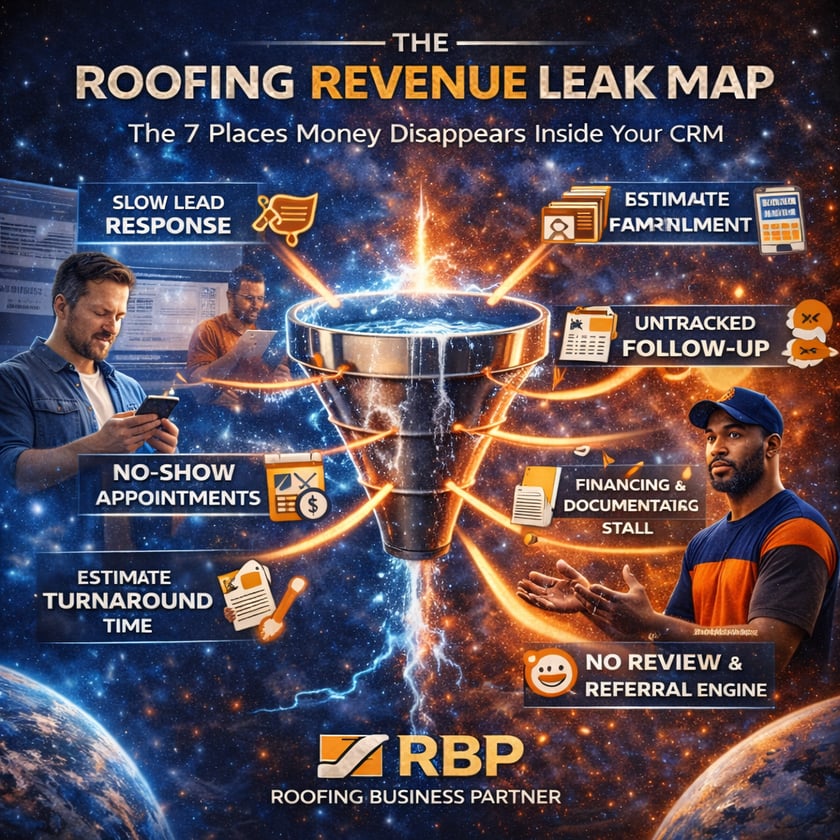
This is the most common story in the industry:
the phones are ringing
jobs are happening
marketing is working
the owner is exhausted
cash flow feels tight
margins are shrinking
and everyone feels behind
What’s happening?
You’re increasing volume…
but you’re leaking money at every handoff.
Growth doesn’t fix leaks.
Growth magnifies leaks.
So if your business feels busier but not healthier, your first move isn’t more leads.
Your first move is plugging the holes.
Here are the seven most common places roofing companies leak revenue.
You might be dealing with one.
But most companies are dealing with four or five at the same time.
A lead comes in. Nobody answers. The customer moves on.
This leak is brutal because it’s completely invisible to most owners.
You don’t even know the deal existed.
Leak symptoms:
missed calls
form fills sitting in the CRM
leads going to one salesperson’s phone
response time measured in hours, not minutes
Plug it:
respond in under 5 minutes
route leads automatically
build a backup response plan
track speed-to-lead daily
If you fix nothing else, fix this.
Speed is money.
A rep books an appointment. The customer doesn’t show.
That’s a cost leak and a morale leak.
Because every no-show wastes:
drive time
rep energy
schedule capacity
and opportunity cost
Leak symptoms:
high no-show rate
inconsistent confirmation
no pre-appointment reminder workflow
no “rescue sequence” when customers go cold
Plug it:
send confirmation immediately
send reminder the day before + day of
create a simple “confirm” reply text
have reschedule links ready
Appointments don’t vanish because customers are flaky.
They vanish because uncertainty grows when communication is weak.
This is one of the biggest leaks in roofing.
Customers don’t “think about it” for a week.
They decide without you.
The longer your estimate takes, the more likely you lose the deal.
Leak symptoms:
estimates delivered 2–7 days later
proposals stuck in drafts
“I’ll send it tonight” becomes tomorrow
poor pipeline discipline
Plug it:
standardize your estimate workflow
build templates + pricing rules
track “appointment → proposal” time
set a same-day estimate standard where possible
Speed creates confidence.
This is the most common leak — and the most painful.
Deals don’t die because customers say no.
Deals die because nobody follows up consistently.
Or worse…
Salespeople follow up, but it’s invisible to the business.
If the follow-up isn’t in the CRM, it didn’t happen.
Leak symptoms:
“I’ll follow up later” without a task
no automation for stalled deals
inconsistent contact cadence
follow-up happening in personal phones and DMs
Plug it:
enforce follow-up task creation
create stalled-deal triggers
build a simple follow-up cadence (Day 1, Day 3, Day 7, Day 14)
track “touches per deal” and “days stalled”
Follow-up is not effort.
It’s a system.
Roofing companies lose deals at the finish line all the time.
The customer is emotionally committed…
but the paperwork kills momentum.
Financing links don’t get sent.
Documents don’t get signed.
Insurance paperwork sits.
This is the slow death leak.
Leak symptoms:
“pending financing” for weeks
contracts not signed for days
unclear next step messaging
no one owns the paperwork stage
Plug it:
make next steps automatic
send financing + contract immediately
add a “paperwork owner” in your process
track time in finance stage
The customer’s urgency is highest at commitment.
If you let time pass, you lose them.
This leak is margin destruction.
A job changes in production — decking, rot, chimney flashing, upgrades — but the billing never catches up.
Or the change is agreed verbally and never documented.
Leak symptoms:
production making field decisions
supplements missing
invoices not matching reality
profits shrinking mysteriously
Plug it:
change order workflow with required documentation
standard pricing for common upgrades
production coordinator flags changes immediately
invoice cannot close without change order confirmation
If you don’t capture change orders, you’re installing extra work for free.
That’s not customer service.
That’s leaking margin.
This is the biggest long-term leak.
Because reviews and referrals aren’t just nice to have.
They determine:
close rate
ad performance
cost per acquisition
trust
brand strength
Every job that ends without a review request is a missed growth asset.
Leak symptoms:
review requests are inconsistent
only happy customers get asked
production doesn’t own the customer experience
referrals happen accidentally
Plug it:
review request automation tied to completion
customer success workflow
referral ask script for site supervisors
track review request completion rate
You can spend money on leads…
or you can build a referral engine.
One scales margins.
The other scales stress.
Most owners treat these issues as “people problems.”
But most of them are systems problems.
That’s why they show up repeatedly, even with good employees.
Your CRM is not just a database.
It’s the system that should prevent leaks by enforcing:
follow-up
speed
process consistency
handoffs
documentation
accountability
If your CRM doesn’t enforce these things, it isn’t helping.
It’s just tracking chaos.
Here’s how to stop guessing.
Track these three things in every stage:
How much is flowing through the system?
leads per week
appointments booked
proposals sent
jobs scheduled
What percent moves to the next stage?
lead → appointment
appointment → proposal
proposal → close
How long does each stage take?
lead → first contact
appointment → proposal
proposal → close
close → install
If you can see V, C, and T — you can spot the leak immediately.
Leaks always show up as:
conversion drop
time expansion
volume bottleneck
Here’s what to do right now:
Write the stages on a whiteboard:
Lead → Appointment → Proposal → Close → Production → Invoice → Review/Referral
Ask:
Where do deals stall? Where does time expand? Where does conversion drop?
Don’t rebuild everything.
Plug one leak.
Measure.
Then plug the next.
Your CRM should notify you when:
a lead hasn’t been contacted in 5 minutes
a deal hasn’t been touched in 3 days
an estimate hasn’t been sent in 24 hours
paperwork is stalled
a job is complete but review request wasn’t sent
Leaks are predictable.
So build alerts.
Leak control isn’t a one-time project.
It’s a weekly maintenance habit.
A lot of roofers think growth means more marketing.
But real growth means:
the same amount of marketing produces more revenue.
And the fastest way to do that is plugging revenue leaks.
Because if your bucket isn’t leaking…
every lead becomes more valuable.
Every appointment converts better.
Every job produces trust.
Every review makes ads cheaper.
That’s how you scale profitably.
At RBP Roofing Business Partner, we help roofing companies build CRM + marketing systems that don’t just track leads — they close gaps, eliminate leakage, and create predictable growth.
If you want a Leak Map Audit of your CRM and pipeline, we’ll show you exactly where money is disappearing — and how to stop it.
You only get one name.
Your reputation is everything.
And what’s right is right.

Adam Sand : Nov 28, 2024, 9:00:00 AM

Adam Sand : Nov 18, 2024, 6:43:29 PM
The $3 Million Prison: A Roofing CEO's Guide to Freedom

Adam Sand : Dec 22, 2022, 8:12:00 AM
As a successful business owner and entrepreneur, I have always looked to various thought leaders and influencers for advice. One individual that...