
.png?width=200&height=86&name=RBP_Logo-Design_02%20(1).png "RBP White Logo")

 Adam Sand
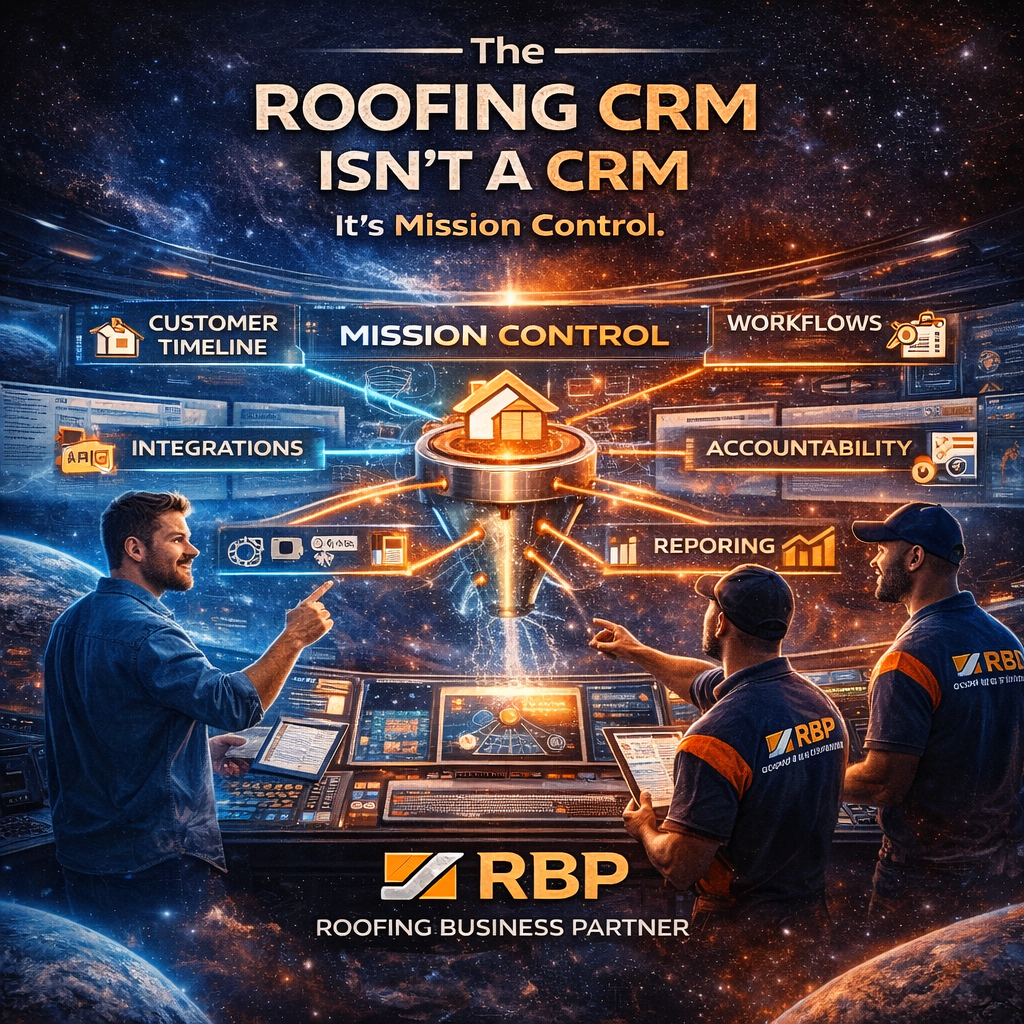
The Roofing CRM Isn’t a CRM: It’s Mission Control — and here’s what it must control.
 Adam Sand : Jan 21, 2026, 7:00:04 AM
Every roofer eventually asks the same question:
How many of you have felt like you're stuck in a CRM nightmare? You bought it, you set it up—or tried to—and now it's just more work. More frustration. More money down the drain.
You're not alone. According to industry research, CRM implementation failure rates range from 30% to 70% depending on the study [Source: Gartner CRM Research, 2024]. In the roofing industry, with its unique operational complexity spanning sales, production, and field service, I'd estimate that number runs even higher. I've seen this pattern play out with hundreds of companies, from $2 million operations to $40 million enterprises—and I've given it a name.
The CRM Doom Loop.In this article, I'm going to walk you through exactly why roofing CRM implementation keeps failing, why the "all-in-one CRM" is usually a trap, and most importantly—how to escape the loop and build a system that actually works for your business.
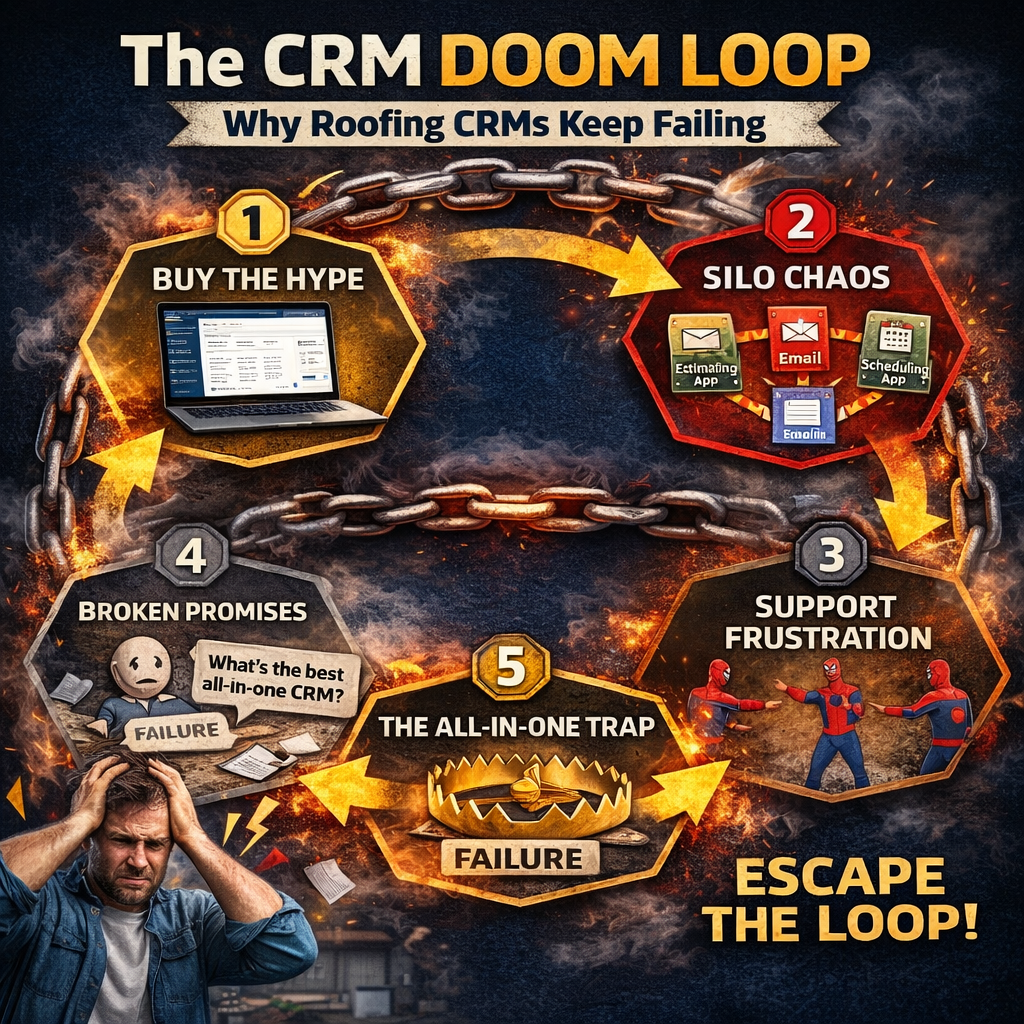
The CRM Doom Loop is a predictable, cyclical pattern that roofing companies fall into when trying to improve their technology systems. It has five stages, and once you see it, you'll recognize it everywhere.
| Stage | What Happens | Warning Sign |
|---|---|---|
| 1. Shadow Silos | Departments adopt tools independently | "We have 3 different ways to..." |
| 2. Frustration Build | No single source of truth, reporting nightmares | Pulling data from 4+ systems for one report |
| 3. Requirements Spiral | Mile-long wish lists, endless vendor meetings | "We need a CRM that can..." lists |
| 4. Support Spider-Man | Vendors blame each other, no ownership | "That's a problem with their tool" |
| 5. All-in-One Illusion | Facebook search, biased advice, new purchase | "What's the best all-in-one CRM?" |
Here's the trap: Stage 5 leads right back to Stage 1. You buy the new "all-in-one" system, departments start adding their own tools around it, silos form, and the loop repeats.
I've watched this happen with companies that spent over a million dollars trying to get their CRM right. They were on their fourth system. Same problems. Different interface.
The pattern is predictable—and therefore escapable. But first, you need to understand each stage.
I call them shadow app silos. Sometimes you don't even know they're there because departments are trying to solve departmental needs inside these new apps. But they create silos of data that nobody can see across.
The roofing industry's technology landscape has exploded in recent years. According to the National Roofing Contractors Association's 2024 Annual Market Survey, roofing contractors now use an average of 6-8 different software applications across their operations [Source: NRCA Annual Market Survey, 2024]. Your sales team discovers an amazing estimating tool. Your marketing team is all about that fancy email platform. Your production team finds a project management app that "changes everything."
You want Rilla for sales coaching. You want Hover or EagleView for measurements. You want three different tools to get different jobs done. Each one solves a problem. Each one creates a silo.
Here's a real example: You end up with 3 CompanyCam projects for one house because three different things are sending CompanyCam projects. You wanted them to integrate, and you integrated them. But now they don't know that the other integration already created a project.
So you have duplicate records, no single source of truth, and data scattered across platforms. Nobody has the full picture.
Ask yourself:
If you answered "more than two" to any of these, you have shadow silos. Right? And that's where the frustration starts.
Here's what happens next. You get frustrated. You can't get a clear picture of your customer journey. Reporting is a nightmare. Nothing integrates properly.
So you sit everybody down and create new requirements. "We need this! We need that!" You end up with a mile-long list of changes your CRM needs to make.
Then you try to get help. You call support. You call CompanyCam support, and your estimating tool support, and your CRM support. And it feels like you're talking to the 3 Spider-Mans, right? Where they just keep saying:
> "Oh, that's a problem with their tool. That's a problem with their tool."
Nobody can take ownership over your success. Every vendor points at the other vendor.
The 3 Spider-Man Symptoms:The root cause? You've built a tech stack without an integrator—someone responsible for the connections between tools, not just the tools themselves.
So every business owner comes to this place. You're at the end of your rope. But it's also where you get this bright idea. Right? Something clearly nobody would have thought of. This is the answer. You're the visionary.
You run off to Facebook and post:
> "Hey. What's the best all-in-one CRM? I want just one CRM to do it all."
I see this question get asked every single day.
Here's the problem: those responses are biased.
You're not getting great advice. You're not getting unbiased advice. Like, if my response is in there, it's biased too. Right?
And the bigger truth: most CRMs are good at some things, but they're terrible at a lot of other things. They're still sold as an "all-in-one," but no single tool does everything exceptionally well for roofing operations.
So you get this new CRM, and you repeat the doom loop.
Here's the way out. Rather than thinking of your CRM as a destination, you want to look at it as an iterative project.
You're gonna grow faster, for less money overall, with less risk—because you're living in constant improvement.
Now I get it. If I'm planning on selling you CRM number two, telling you to keep CRM number one and improve it iteratively is probably not good for my sales. And that's okay. Because, again, you only get one name, and your reputation is everything, and what's right is right.
| Destination Mindset (WRONG) | Journey Mindset (RIGHT) |
|---|---|
| "Find the perfect CRM" | "Build the right ecosystem" |
| One-time implementation | Continuous improvement cycles |
| All features on day one | MVP first, expand based on data |
| Replace everything | Integrate and connect |
| Set and forget | Monthly review cadence |
If you're measuring these three things, you can improve anything:
V = VOLUME How much is flowing through your system?Industry benchmarks suggest top-performing roofing companies achieve lead-to-appointment rates of 40-50%, with proposal close rates between 30-45% depending on lead source and market conditions [Source: Roofing Contractor Magazine Industry Benchmarks, 2024].
T = TIME How long does each stage take?Before any system change, ask yourself:
> "Will this improve our Volume, Conversion, or Time?"
If you can't answer yes to at least one, don't make the change.
This simple rule cuts through all the noise. Instead of arguing about features and integrations, you ask: "Did this change improve V, C, or T?" If yes, keep it. If no, adjust.
The things you learn from the doom loop, the failure points, the integration challenges—you put these into what I call Mission Control. It's a systematic approach that overlays on top of your CRM.
Instead of asking "Which CRM should I buy?", ask "How do I orchestrate the tools I have into a system that works?"
Mission Control Components:If it sounds like a lot of work, it is. It's an absolute ton of work. But this is what makes good roofing companies grow—the fact that they're ready and watching for the CRM doom loop. They're aware of it. They're looking for the failure points.
They make maintenance and improvement of systems a part of their business, not a one-time project.
The CRM doom loop is real. I see roofing companies stuck in it every single day. But it's not inevitable.
The escape is simple, but not easy: Stop looking for a destination. Start building a process of continuous improvement.
Here's your action plan:
Remember: If you learn something and don't take action based on what you learned, you have learned nothing.
The doom loop is predictable. The escape path is clear. The question is whether you'll take the iterative approach—or keep searching for that perfect all-in-one that doesn't exist.
You only get one name. Your reputation is everything. And what's right is right.
Build from there. Measure. Adjust. Improve.
That's how you break free from the CRM doom loop. That's how you build systems that actually scale with your roofing business.
Adam Sand : Jan 21, 2026, 7:00:04 AM
Every roofer eventually asks the same question:
Adam Sand : Jan 14, 2026, 7:00:02 AM
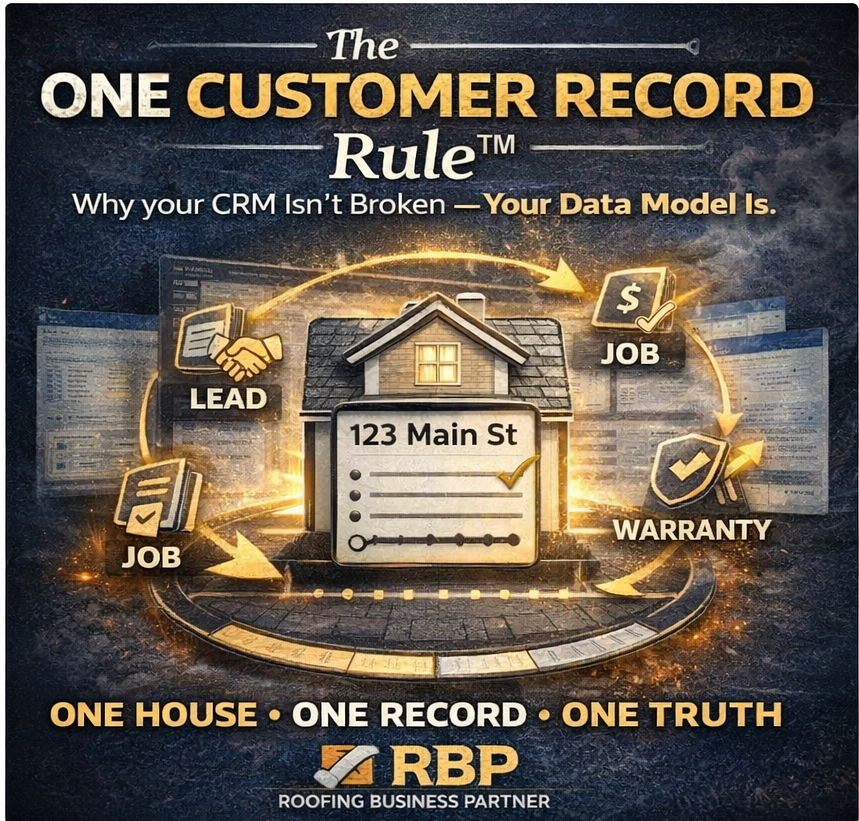
The One Customer Record Rule™ Why your CRM isn’t broken — your data model is. Let me guess what happened.
6 Reasons Why Your Roofing Company Needs A CRM in 2023 What is a CRM? A Customer Relationship Management system is an invaluable tool for businesses...