Here's a question that stops most roofing operators cold: "What's the exact math that makes e-commerce sustainable for your company?"
Most roofers who've added a "Buy Now" button to their website can't answer this. They know roughly what they're saving on marketing. They have a sense that they're paying less in commissions. But they haven't built the specific financial model that tells them exactly when to say yes to a deal and when to walk away.
That's dangerous. Because in roofing e-commerce, the difference between a sustainable business model and a race to the bottom often comes down to a few percentage points.
In this article, I'm going to walk you through what I call the 3% Rule™—the framework that determines whether your e-commerce channel builds profit or erodes it.
The E-Commerce Value Stack
Before we get to the 3%, we need to understand what you're actually saving when a customer buys online versus through traditional channels:
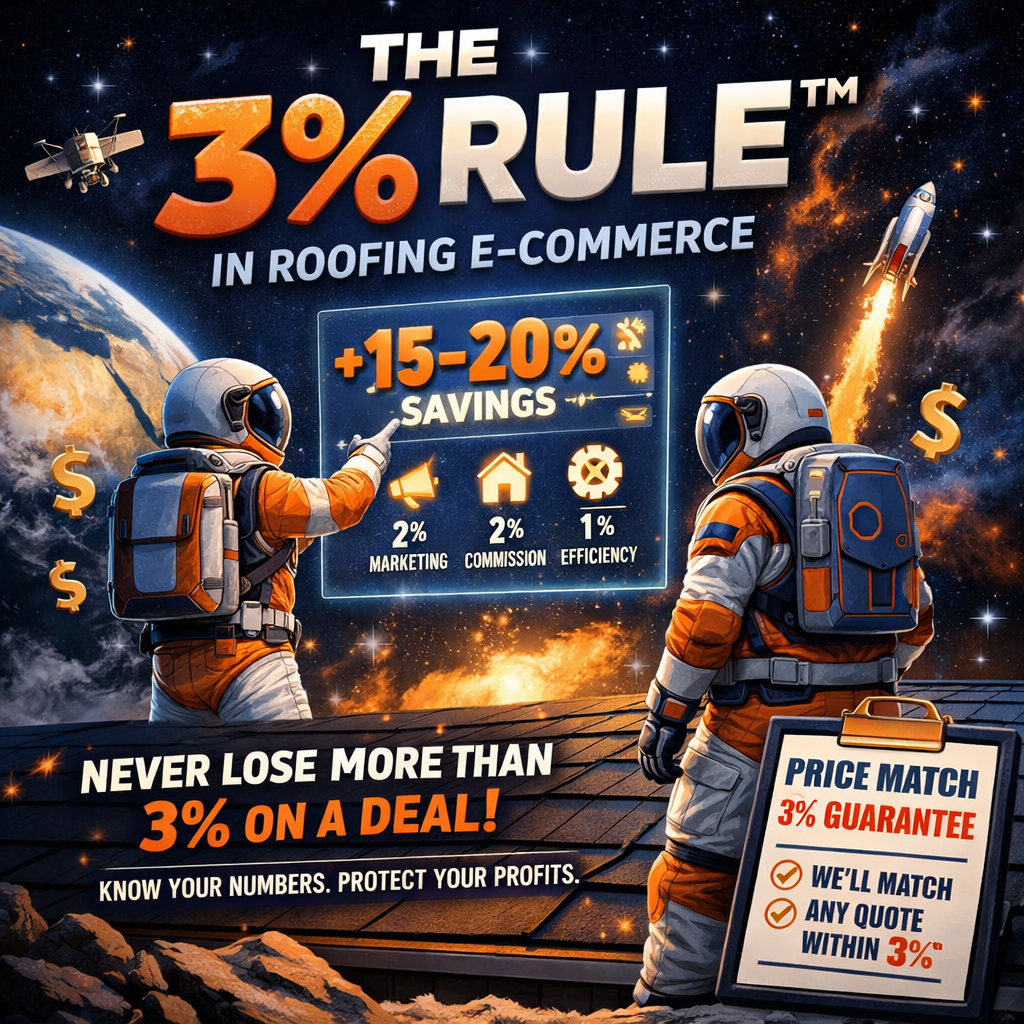
Marketing Cost: From 8-12% to 2%
Traditional roofing customer acquisition costs run 8-12% of revenue. E-commerce can compress this to roughly 2%—you're still paying for visibility, but you're eliminating much of the manual follow-up cost.
Commission Cost: From 10% to 2%
A typical sales rep earns 8-12% commission on closed deals. With e-commerce, that drops to around 2%—you might have customer success staff helping with questions, but you don't need the full sales process.
Operations Efficiency: Another 1%
Electronic contracts, automated scheduling, and digital payments create roughly 1% in operational savings compared to paper-based, phone-call-heavy traditional processes.
The 3% Rule Explained
Add it up: you're saving roughly 15-20 percentage points compared to traditional selling. That's your margin of safety for competitive pricing.
But here's where most roofers go wrong: they pass ALL of that savings to the customer. That's not sustainable pricing—that's buying market share with your margins.
The 3% Rule says this: your loss threshold on any e-commerce deal should be 3% of contract value. That's the maximum you're willing to lose on a single transaction to win market share and build reputation.
Building Your Price-Match Guarantee
This 3% number becomes the foundation of your price-match structure:
"We'll match any written quote within 3% of our price, guaranteed."
This promise is powerful because:
- It eliminates price shopping anxiety for customers
- It's specific enough to seem credible (not "we'll beat any price")
- It's backed by real math you can sustain
When to Break the Rule
- Reputation building—If you're under 100 reviews, acquiring reviews may justify deeper discounts
- Market entry—When entering a new geography, initial deals may need more aggressive pricing
- Strategic accounts—HOAs, property managers, or other repeat customers may warrant investment pricing
Action Steps
- Calculate your actual e-commerce cost structure. What are you really paying for marketing, commission equivalents, and operations per e-commerce deal?
- Determine your loss threshold. Based on your margins and growth goals, is 3% the right number for you?
- Build your guarantee language. Create a clear, specific price-match promise that you can sustain at scale.
- Track deal-level profitability. Make sure you're actually achieving the cost structure you planned for.
E-commerce isn't just a sales channel. It's a fundamental restructuring of your cost base that enables pricing strategies your competitors can't match.

.png?width=200&height=86&name=RBP_Logo-Design_02%20(1).png "RBP White Logo")

 Adam Sand
 Adam Sand : Jan 12, 2026, 7:00:03 AM