The Production Octopus is a 4-role organizational framework that transforms chaotic roofing operations into a scalable production machine—and it's the difference between owners who work 70-hour weeks and those who actually run a business. Most roofing companies try to scale production by adding bodies. They hire more people, throw them at problems, and wonder why quality suffers and margins shrink.
The real solution isn't more people. It's the right roles, in the right structure, with the right responsibilities. I've implemented this framework in companies from $2.5 million to $40 million, and the pattern is always the same: companies that get the octopus right scale smoothly. Companies that don't get stuck in the doom loop of owner-dependency.
In this article, I'll walk you through the four roles of the Production Octopus, teach you Tetris scheduling (the core skill every production manager needs), and show you the $19,000 math that proves site supervisors pay for themselves.
If you learn something and you don't take action, you really learn nothing. So let's make sure you leave with something to implement today.
Key Takeaways:
The Production Octopus has 4 roles: Brain (PM), Eyes (Field Manager), Arms (Site Supervisors), Mouth (Coordinator)
Tetris scheduling is the production manager's core skill for maximizing revenue per crew day
One site supervisor prevents $19,000+ in losses—126 jobs worth of site supervisor cost from just 3 disasters
You can't bonus production managers on profitability unless they control what sales sells
The Production Octopus: Why Your Flat Structure Won't Scale
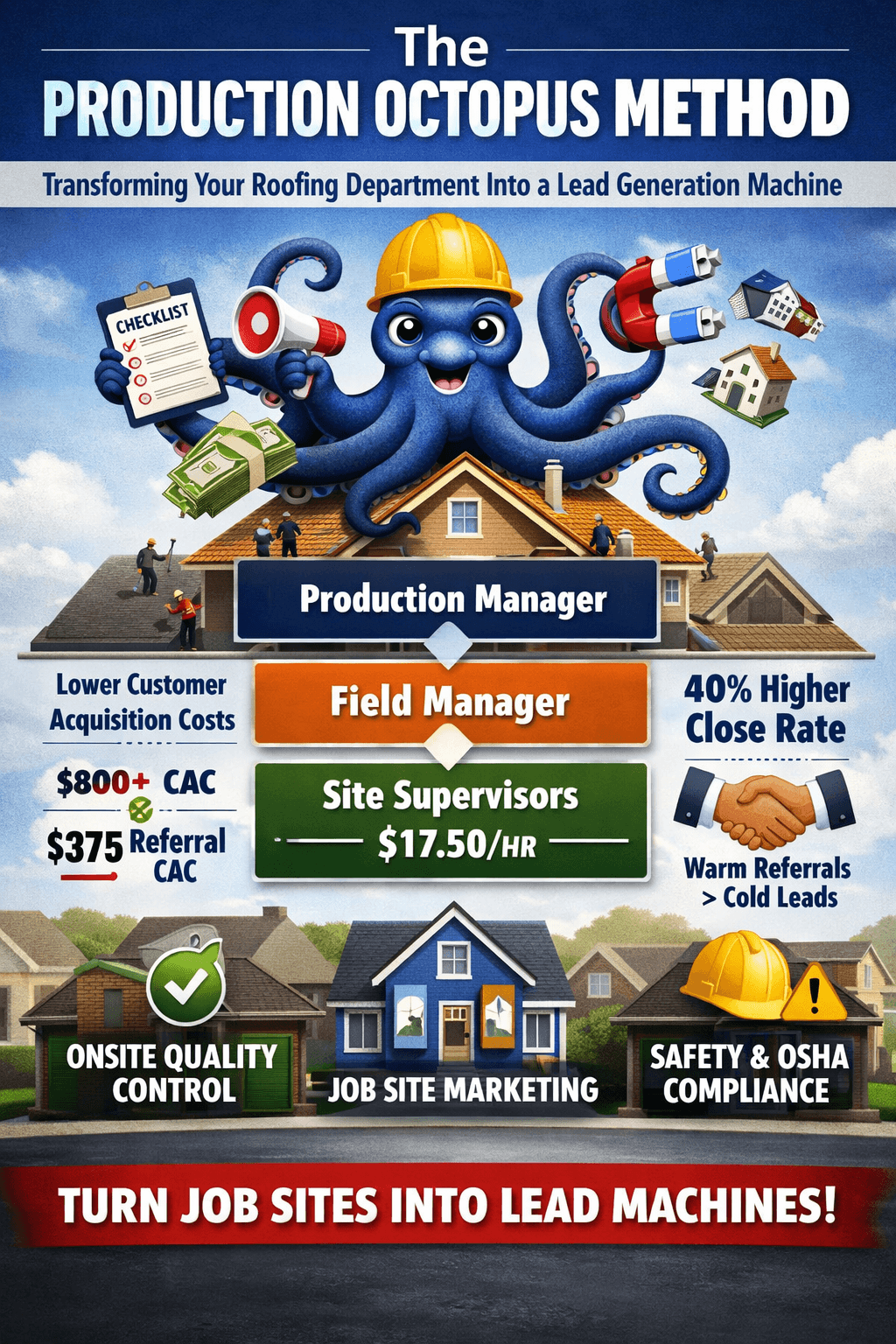
The Production Octopus is a framework where each role has a specific function, just like the parts of an octopus. The production manager is the brain—strategic, forward-looking, managing vendors and the production calendar. The field manager is the eyes—out in the field, seeing what's happening, calling audibles. The site supervisors are the arms—doing the actual work on job sites. And the production coordinator is the mouth—handling customer communication and administrative efficiency.
The octopus keeps the brain at its desk while the arms do the work.
Here's why this matters: at most roofing companies, the production manager is constantly pulled into the field. They're putting out fires, checking on crews, dealing with customer complaints. They're supposed to be looking forward—scheduling jobs, managing materials, planning capacity. Instead, they're looking backward—reacting to problems that already happened.
According to the NRCA's 2024 industry survey, 85% of roofing contractors struggle to hire skilled labor. The Production Octopus addresses this by creating clear role separation so the talent you do have operates at maximum effectiveness.
Role
Body Part
Core Function
When to Hire
Production Manager
Brain
Vendors, calendar, strategy
Owner exits operations (~$2.5M)
Field Manager
Eyes
Field leadership, audibles
Multiple crews daily
Site Supervisors
Arms
Job site execution, customer face
1+ crews per supervisor
Production Coordinator
Mouth
Customer comms, admin
4-6 jobs/day workload
The Four Roles of the Production Octopus
Production Manager: The Brain
The production manager is the leader of the entire production department. You're responsible for outcomes. You're the primary decision maker on hiring and production scheduling. You manage supplier and vendor relationships. You own the production calendar.
Until installation day, you're the primary point of contact for homeowners, crews, subs, and suppliers. You decide when to send invoices and when to incur costs. You deal with customer heat.
The key insight is that production managers shouldn't be in the field. They should be at their desk, looking forward at the calendar, planning capacity, and solving problems before they happen.
Every minute a PM spends in the field is a minute they're not preventing next week's disasters.
Field Manager: The Eyes
The field manager keeps the production manager at their desk. That's their core function. They're out in the field, leading site supervisors, calling audibles, and handling the real-time complexity of active job sites.
They're the flawless installation torch bearer—the expert who ensures quality standards are maintained. They provide site support when crews run into problems. They control delivery and costs by making field-level decisions.
When something goes wrong at 2 PM on a Tuesday, the field manager handles it so the production manager can keep planning Thursday's jobs.
Site Supervisors: The Arms
Site supervisors are the hands of production. They're on site all day, every day. They're the face of your company to the customer. They're the marketing presence—the person the homeowner sees and judges you by.
More importantly, they're the creator of opportunities. When a site supervisor does great work, they generate referrals. According to referral marketing research, referred customers have a 37% higher retention rate. In roofing, that translates to repeat business and neighborhood word-of-mouth.
Their job is simple: keeper of flawless job sites. They don't have to be better roofers than the roofers. They have to be better at making sure the job site runs smoothly.
Production Coordinator: The Mouth
At 4 to 6 jobs per day, the production manager hits a wall. That's 4 to 6 material orders, 4 to 6 work orders, 4 to 6 customer communications, 4 to 6 scheduling conversations.
The coordinator is the capacity force multiplier.
The production coordinator becomes the primary point of contact for customers. The production manager still handles vendors, suppliers, and crews—they understand what it takes to do a job. But the coordinator handles customer communication, provides administrative efficiency, and serves as the frontline of defense for customer heat.
Tetris Scheduling: The Production Manager's Core Skill
Tetris Scheduling: The Production Manager's Core Skill
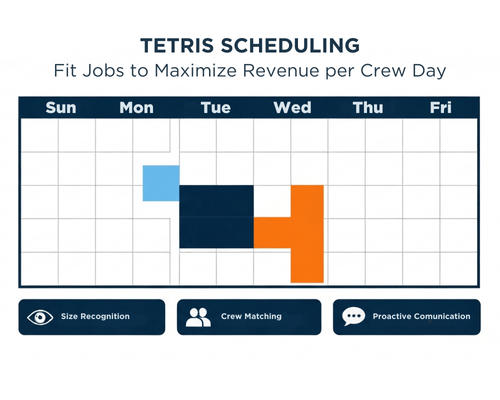
The core skill of a production manager is Tetris scheduling. You're looking at jobs coming in, knowing roughly how long each one takes, and maximizing revenue per day by fitting them together optimally.
In Tetris, the L-piece always got me in trouble. In production, it's the job with the skylight removal, the steep pitch, and the material delay.
The job that doesn't fit cleanly into your calendar is the one that wrecks your week.
The 3 Tetris Skills:
Size Recognition — You can look at a job file and know: this is a 4-square straight tear-off, one day. This is a two-layer with wood rot, three days. You know the shapes before they land on your calendar.
Crew Matching — You know which crews handle which shapes. Some crews crush steep pitches. Some crews are fast on simple jobs but slow on complex ones. You match the piece to the crew that can handle it.
Proactive Communication — You tell crews what's coming. Set expectations before the job, not during.
Scaling Your Octopus: From $2.5M to $10M
At $2.5 million, the org chart is simple. The owner is likely still playing sales manager. Production is where you start adding leadership first—usually a production manager—because the owner needs to focus on making sure everyone gets paid.
At this stage, your production manager might also be your field manager. Roles overlap because volume doesn't justify full separation.
As you grow toward $10 million, the owner removes from both sales management and production management. You're leading two department heads—sales and production—and managing operational overhead. The octopus fully forms.
Company Size
Owner Role
Production Structure
$2.5M
Still in sales management
PM (may double as FM), Site Supervisors
$5M
Transitioning out of daily ops
PM, FM, Site Supervisors, possibly Coordinator
$10M
Managing department heads only
Full octopus: PM, Coordinator, FM, multiple Site Supervisors
The constraint question at each stage is: "Why can't we double our marketing budget?"
If the answer is "we don't have enough salespeople," that's your constraint. If the answer is "our install schedule would stack up 3 months," that's your production constraint. You add the next octopus role to relieve the constraint that's blocking growth.
The $19,000 Lesson: Why Site Supervisors Pay for Themselves
The $19,000 Site Supervisor ROI Math
Let me tell you about a company in Milwaukee. I was on site for a month, and the owner kept saying he was nervous about paying for site supervisors. $150 per job felt like too much.
Then I watched three disasters happen in two weeks.
Job 1: The Boards Problem
The owner's texting while driving, frustrated with his Atlas rep. Turns out they installed a roof on boards, there were gaps, and the old warranty said no gaps. Customer went in the attic, saw daylight, and now wants warranty coverage.
The sales guy never checked the attic. The crew never mentioned it.
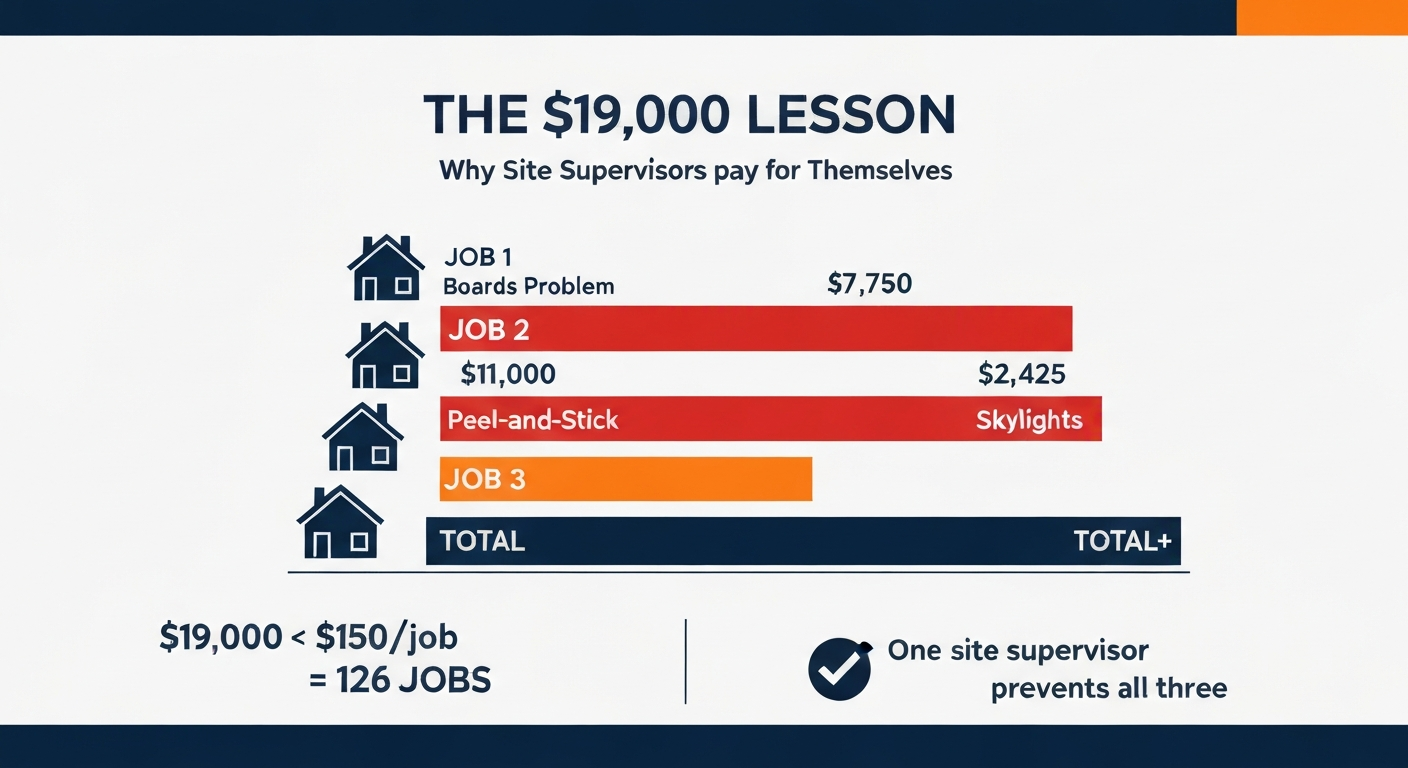
Cost: $6,000 in shingles to redo, plus $1,750 in labor coordination. Plus one lost referral worth $2,200 in net profit.
Job 2: The Peel-and-Stick Disaster
Same week. Different crew. Customer hired an inspector. The inspector looks through the gaps in the boards and sees white backing. The crew didn't remove the peel-and-stick backing from the ice and water shield.
Now they have to rip off the lower four feet of the roof and redo it. The customer's response? "I want the whole thing replaced."
Cost: $8,000 for full labor, $300 delivery, $500 disposal.
Job 3: The Exploding Skylights
Different job, different crew. Threw three skylights off the roof onto the grass. They exploded. Glass everywhere. Three trips at $75 each to clean up.
The Math:
Disaster
Direct Cost
Lost Referral
Total
Job 1: Boards
$7,750
Included
$7,750
Job 2: Peel-and-stick
$8,800
$2,200
$11,000
Job 3: Skylights
$225
$2,200
$2,425
Total
$19,000+
$19,000 divided by $150 per job is 126 jobs.
A $2.5 million company does about 139 jobs per year. These three disasters cost almost an entire year of site supervisor expense.
126 jobs. That's what 3 disasters cost you. One site supervisor prevents all three.
A site supervisor would have seen the boards and stopped the job. A site supervisor watching means crews don't cut corners on peel-and-stick. A site supervisor says "put a tarp down before you toss those skylights."
The Upstream Problem: Why You Can't Bonus on Profitability
Imagine a river. You're traveling upstream, and you see people floating down, drowning, calling for help. You jump in, pull them to shore, do CPR, save them. Then more come.
Someone asks: "Why are these people in the river?"
"There's someone upstream throwing them in."
The obvious answer is to go stop the thrower. But that's not what happens in business. Instead, we tie a rope between two trees and make it easier for our rescue team to grab people. Band-aids. Rogue spreadsheets. Workarounds.
The real function of production management is leadership skills. But leadership can't fix problems created upstream in sales.
This is why you can't bonus production managers on profitability. Can a PM truly control profitability if they can't reject a job that was sold wrong? Unless you're willing to give your production manager the power to say "I decline to produce this job because the sales guy sold it wrong," you can't bonus them on profitability.
You're setting them up to fail on something they don't control.
Better Production Manager Bonuses:
Metric
Why It Works
Callback Percentage
They control installation quality
Squares per Week
They control throughput
Revenue per Quarter
They control team capacity
These counterbalance each other. More squares with more callbacks is bad. The metrics keep each other honest.
You Win the Super Bowl in the Draft
Every framework in this article—the Octopus, the Tetris scheduling, the site supervisor ROI—depends on one thing: hiring the right people.
You win the Super Bowl in the draft. That repair tech you're trying to incentivize into efficiency? You should have drafted better.
The best way to get an efficient repair technician isn't an incentive structure. It's hiring someone who's already efficient, already takes pride in their work, already wants to do a good job.
You can't bonus someone into being who they're not.
The same applies everywhere. Site supervisors who generate referrals do it because they care about the customer experience. Production managers who hit their numbers do it because they're organized and driven.
The obstacle is the way. The impediment to action advances action.
If you're struggling with your production department, the answer usually isn't a new process or a new tool. It's asking whether you drafted the right team.
Build your Production Octopus. Learn Tetris scheduling. Do the site supervisor math. But most importantly, draft the right people into the right roles.
That's how you scale a roofing production department. That's how you stop working 70-hour weeks. That's how you build something that runs without you.

.png?width=200&height=86&name=RBP_Logo-Design_02%20(1).png "RBP White Logo")

 Adam Sand
 Adam Sand : Dec 24, 2025, 7:00:00 AM