The OASIS Framework is a systematic 5-stage roadmap that helps roofing business owners escape the owner-operator trap and scale from startup to $10M+ without burning out. If you're stuck doing everything yourself while your revenue plateaus, this framework shows you exactly why—and more importantly, what to do next.
Most contractors hit an invisible ceiling somewhere between $600K and $1M. It's not because they lack skill or work ethic. In fact, it's often because they're too good at doing things themselves. Brandon Vaughn, founder of Hirebus, calls this the DIY Death Trap—and he's developed a proven system to escape it.
According to research from The Alternative Board, the average business owner spends 68% of their time working "in" the business on day-to-day tasks, and only 32% working "on" the business for strategic growth. This imbalance is exactly what keeps contractors stuck.
In this guide, you'll learn the five stages every successful contractor moves through, how to diagnose exactly what's holding you back, and how to build the team that lets you work on your business instead of in it. For more on building systems-first operations, check out our services and coaching programs.
Key Takeaways:
The DIY Death Trap keeps skilled owners stuck at $600K-$1M by making delegation feel harder than doing it yourself
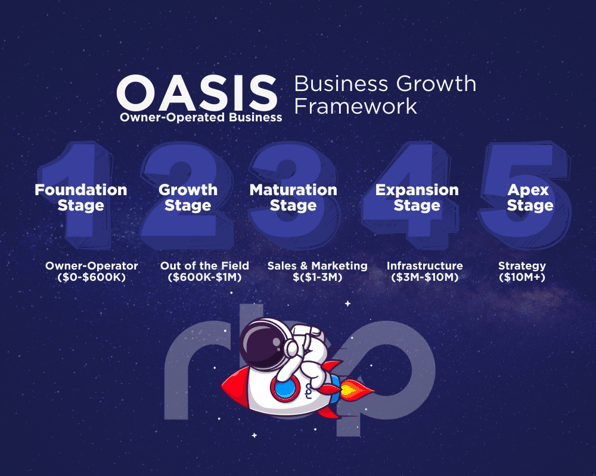
OASIS stands for Operations, Admin, Sales & Marketing, Infrastructure, Strategy—the 5 stages of business growth
The critical transition from Stage 1 to Stage 2 requires getting OUT of the field
The OASIS Scorecard is a 40-question diagnostic that identifies your specific bottleneck
Building a talent bench before you need to hire is as important as customer acquisition
The DIY Death Trap: Why Your Best Skills Are Limiting Your Growth
The DIY Death Trap is the paradox where your greatest strength becomes your biggest limitation.
When you're good at figuring things out and you've always been good at DIY-ing stuff, it's really hard to let go. Brandon learned this firsthand. As a second-generation home service business owner—his father was an owner-operator window cleaner for 33 years—he fell into the same pattern when he started his own window cleaning company in 2012.
He bought a vinyl plotter and heat press machine to make his own uniforms because "professional ones were too expensive." He did his own lettering on white vans. When he needed to remodel the shop parking lot, he rented an excavator—never having driven one before. He bought a fixer-upper property because he could "do it himself."
Sound familiar? This is the trap.
The $600K Ceiling
Here's what happens when you do everything yourself. Maybe you can push to $600K. Maybe stretch to $1M if you're an extremely aggressive salesperson. But you're going to be in a lot of pain.
You're stressed all the time. The office is chaotic. You're missing quotes. You're having a hard time following up with customers. Things are slipping through the cracks left and right. You just can't find the time because there's so much work that needs to be done.
This ceiling isn't about capability—it's about capacity. You only have so many hours. The math doesn't work.
Two Choices
Brandon puts it simply: "In order to get somewhere you've never been means doing things you've never done."
You have two choices when you want to grow beyond where you are now. You can be the person who figures everything out and fixes everything yourself. Or you can find people who are better than you, smarter than you, who come in and help build the business.
The difficult part about bringing other people in is you have to set them up for success. For entrepreneurs who are good at doing things themselves, this is very, very difficult. But it's the only way forward.
The OASIS Framework: Your 5-Stage Growth Roadmap
The OASIS Framework turns entrepreneurial chaos into systematic scale.
Brandon developed this framework to map the five stages most successful companies grow through. The acronym stands for:
O – Operations
A – Admin
S – Sales & Marketing
I – Infrastructure
S – Strategy
These aren't just functional areas of a business—they represent the stages of growth and where your focus needs to be at each level. You may call these things different names, but successful entrepreneurs follow these same patterns repeatedly.
In Stage 1, you're wearing every hat in the business. You're out in the field talking to customers, setting up projects, maybe even being on the roof. You're selling jobs, managing jobs, ordering products, scheduling deliveries. You're taking care of billing and payroll. Literally everything.
Your org chart? It's just you. Maybe an assistant.
Many business owners get stuck in Stage 1 for decades. Brandon's father was one of those prime examples—owner-operator for 33 years. Same org chart year after year.
The key question for Stage 1: "Am I still doing the work?"
Stage 2: Out of the Field ($600K-$1M)
The most important thing if you're stuck in Stage 1 is making the critical transition: move from IN the field to OUT of the field. Your business will never grow if you don't make this shift.
In Stage 2, you're now a project manager and salesperson. You're coordinating operations, maybe still doing some production management. You're meeting with leads or foremen and keeping crews busy. You have someone in the office helping out.
You're still doing a lot. But you've created breathing room.
The key question for Stage 2: "Who handles the back office?"
Stages 3-5: Sales, Infrastructure, Strategy
Stage
Focus
Revenue Range
Key Question
Stage 3
Sales & Marketing
$1M-$3M
"Who's selling besides me?"
Stage 4
Infrastructure
$3M-$10M
"Can this run without me daily?"
Stage 5
Strategy
$10M+
"What's the 3-year play?"
The OASIS Framework: 5 Stages of Business Growth
Stage 3 means your focus shifts to sales and marketing. You have an operations manager handling field work, an office manager handling admin. You're hiring your first dedicated salesperson.
Stage 4 is about building infrastructure. Department heads are in place. Systems are documented and repeatable. You're working ON the business, not IN it.
Stage 5 means your role is vision, strategy, and growth. An executive team runs operations. The business can function without your daily involvement.
The Field-to-Office Shift: The Critical Transition
Stop being the answer. Start being the coach.
The single most important transition in your business is moving from Stage 1 to Stage 2. Everything else depends on it. If you're still doing the work, you can't manage the work. If you can't manage the work, you can't grow.
The 5-Step Shift Process
Here's how to make the transition:
The 5-Step Field-to-Office Transition Process
Identify your best crew member with leadership potential. Look for someone who already takes initiative and earns respect from peers.
Train them to be the lead. Walk them through every process, every decision point, every customer interaction.
Become their assistant. Yes, you do the grunt work. They direct the projects. This feels backwards, but it's essential.
Let them direct while you coach. Your job is to guide, not fix. When they make mistakes, ask questions instead of taking over.
Gradually reduce your field presence to zero. The goal is to become unnecessary in day-to-day operations.
The 33-Year Warning
Brandon's father was an owner-operator window cleaner for 33 years. Same org chart. Same revenue range. Same ceiling.
This isn't a failure of effort. He worked incredibly hard for three decades. It's a failure of transition. He never made the shift from doing the work to building the team that does the work.
Don't let this be you. The transition is uncomfortable. It feels like you're losing control. But it's the only path to scale.
The OASIS Scorecard: Find Your Bottleneck
The scorecard tells you which problem to solve first.
The OASIS Scorecard is a 40-question assessment that reveals exactly what's holding your business back. Instead of guessing or working on everything at once, you get a clear picture of your specific bottleneck.
How the Scorecard Works
The assessment covers 8 different areas across all 5 stages. You score each area on a scale of 1 to 10 based on how well-documented and repeatable your processes are.
Once complete, you receive a color-coded priority map:
Color
Meaning
Action
🔴 Red
No documented process exists
Fix immediately
🟠 Orange
Process exists but inconsistent
Prioritize this quarter
🟡 Yellow
Working but improvable
Schedule for improvement
🟢 Green
Systematized and repeatable
Maintain
Red areas indicate the most critical gaps—places where you have no documented, repeatable process.
The Bottleneck Question
Here's the fundamental question the scorecard answers: Are you demand constrained or supply constrained?
Demand constrained means you don't have enough leads or customers. You need more marketing, better sales processes, improved follow-up systems.
Supply constrained means you don't have enough crew or capacity to deliver. According to the U.S. Bureau of Labor Statistics, the roofing industry expects 13,600 new job openings annually, primarily due to retirements.
Most business owners work on both simultaneously and make progress on neither. The scorecard forces clarity.
Build the Bench: The Continuous Recruitment Philosophy
Talent acquisition is as important as customer acquisition. You can buy leads, but you can't buy culture.
Most business owners hire reactively. Someone quits on Friday, and they're scrambling Monday. This reactive cycle keeps you perpetually behind, accepting whoever's available instead of choosing the best fit.
Brandon's approach is different: treat recruiting like customer acquisition—always on, never reactive.
The 280-Technician Example
One of Brandon's Hirebus clients built a candidate bench of 280 pre-vetted technicians. When someone leaves or the business expands, they hire in days, not months. Rapid replacements. Operational continuity. Zero scrambling.
This isn't magic. It's a system.
Implementation: Always-On Recruiting
Here's how to build your bench:
Keep job ads running even when fully staffed. The pipeline never stops.
Conduct first-round screening continuously. Use tools like Hirebus to handle applicant review and initial interviews.
Maintain a warm list of pre-qualified candidates. These are people who passed screening but you didn't have a spot for.
When you need someone, they're ready. No starting from scratch. No desperate hiring.
For more strategies on building high-performing teams, explore our blog resources.
Proof It Works: The Garage Floor Coatings Case Study
"I work less than one hour a week in this company, and from the beginning, I've averaged about one to two hours."
Brandon doesn't just teach this framework—he lives it. In 2021, he launched a garage floor coatings business to prove the system works even when starting from zero.
The Timeline
Milestone
Result
Month 2.5
7 employees hired
Month 4
First 7-figure revenue month
Year 1
Crossed $1M annual revenue
Current
39 locations, ~$2M/month
His CEO, Whitney, grew this entire business. Brandon worked about one to two hours per week on average—while holding a full-time job elsewhere.
The Key Insight
This isn't about working harder or being smarter. Brandon is direct about this: "I'm not some person that's unlocked the secrets to the universe. I'm not super, super smart. I just listen."
He listened to mentors. He followed proven paths. He focused purely on the systems side of the business. He found people better than him and set them up to succeed.
The framework works. The question is whether you'll implement it.
Taking Action: Your Next Steps
In order to get somewhere you've never been means doing things you've never done.
The path forward is clear. The tools exist. The only question is whether you'll take the first step.
Step 1: Complete the OASIS Scorecard
Score yourself honestly across all five stages. Identify your red areas—those are your immediate priorities. Don't try to fix everything at once. Focus on the bottleneck.
Step 2: Determine Your Constraint Type
Are you demand constrained (not enough leads) or supply constrained (not enough capacity)? This single question changes everything about where you focus your energy and resources.
Step 3: Make the Critical Transition
If you're stuck in Stage 1, your first priority is getting out of the field. Train a lead. Become their assistant. Start coaching instead of doing.
Step 4: Start Building Your Bench
Don't wait until you're desperate to start recruiting. Turn on always-on job ads this week. Build your candidate pipeline before you need it.
Ready to take the next step? Contact us to learn more about implementing systematic growth in your roofing business.
About the Framework
The OASIS Framework and Scorecard were developed by Brandon Vaughn at Hirebus. For questions, free assessments, or demos of the Hirebus platform, contact: bvaughn@hirebus.com
This content was created in partnership between Roofing Business Partner and Hirebus. Special thanks to Brandon Vaughn for sharing his framework and expertise.
The roofing industry has long been characterized by fierce competition, commoditized pricing, and countless small businesses vying for market share....

.png?width=200&height=86&name=RBP_Logo-Design_02%20(1).png "RBP White Logo")

 Adam Sand

 Adam Sand : Dec 26, 2025, 7:00:00 AM

